How to choose air conditioning in Orihuela Costa, Torrevieja and Alicante
Wall-mounted split, multi-split or ducted air conditioning? What to consider when choosing a system in Orihuela Costa, Torrevieja or Alicante.

If you’re choosing air conditioning for a flat or a house, start with two questions: how many rooms do you want to keep comfortable, and will you use the system for heating in winter? Then compare system types, energy efficiency and where the equipment can go. Floor area alone isn’t enough to decide.
Split, multi-split or ducted air conditioning?
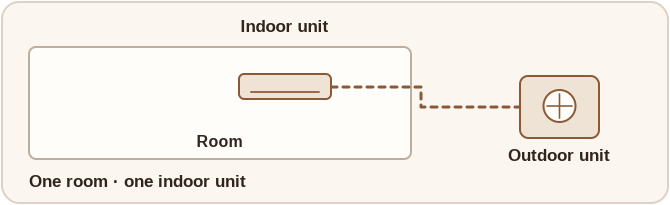
Split system: one indoor unit and one outdoor unit. It’s often the first option for a bedroom, home office or separate living room. If you need to cool two rooms with their doors closed, cooling one room isn’t a substitute for a separate solution in the other.
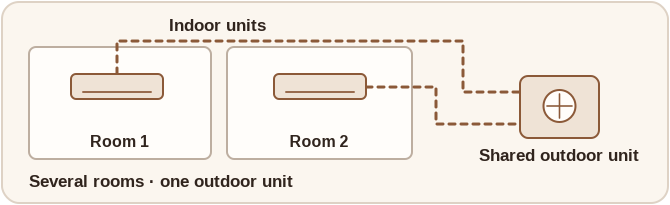
Multi-split system: two or more indoor units share one outdoor unit. Each room has its own indoor unit and there is less equipment on the façade. If several rooms will be heated or cooled at the same time, the outdoor unit’s combined capacity must suit that load. If space allows, it can be worth comparing a multi-split with two independent split systems.
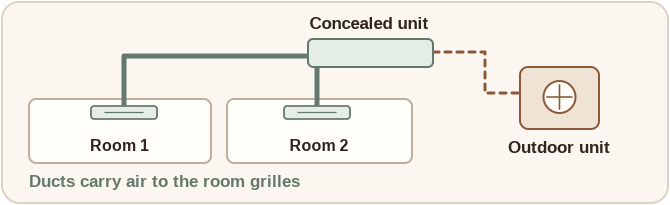
Ducted air conditioning: an indoor unit is concealed above the ceiling and delivers air to the rooms through ducts. It’s an option to consider during renovation or where ducts are already in place. With a replacement, we first check whether the existing ductwork is suitable and whether there is access for servicing. For individual room temperature control, a compatible Airzone system can be considered.
Why the BTU figure isn’t enough
A figure such as 9,000 or 12,000 BTU/h tells you how much heat the unit can remove per hour in cooling mode. It doesn’t tell you how much electricity it draws. Two 25 m² rooms can need different capacities: one may have a small window and a closed door; the other may have full-height west-facing glazing and open directly into the kitchen. In Orihuela Costa and Torrevieja, sunshine and shading deserve particular attention, along with ceiling height, insulation and the number of rooms the system will serve.
An undersized unit may struggle in hot weather. An oversized unit that cannot lower its output far enough may reach the set temperature quickly and keep switching on for short periods without dehumidifying effectively. Assess the property first, then choose a model with the capacity and operating range it needs.
What the energy label says about electricity use
SEER measures seasonal cooling efficiency and SCOP measures seasonal heating efficiency. Neither is a capacity rating. For comparable work under standard test conditions, a higher value means the unit needs less electricity to provide the same amount of cooling or heating.
Compare models of similar capacity, and compare SCOP for the same climate zone. If the air conditioner will be your main source of heating, also compare how much heat each model delivers at outdoor temperatures typical for your home.
The annual kWh figures on the label let you compare equipment using the same method. They aren’t a forecast of your bill: actual use depends on the weather, the temperature setting, insulation and how long the unit runs.
A newer inverter model may run more efficiently than an older unit, particularly if you use it often and for long periods. But age alone isn’t a reason to replace a unit that works properly. Consider replacement if it breaks down regularly, no longer serves the room well, parts are hard to find or a costly repair is due. Compare a repair quote with the cost of specifying and fitting a new system. If you do need a replacement, ask whether removing the old unit during the new installation and checking the existing pipework are included in the scope. It depends on the property.
Where to position both units before installation
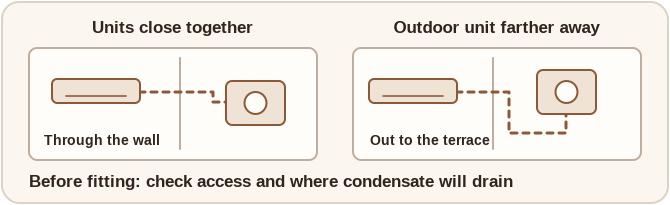
The indoor unit needs a clear air intake and a position that distributes air around the room without blowing directly onto the bed or sofa. The outdoor unit needs clear airflow and room for servicing. Plan the route for the pipework and where condensate will drain. If the outdoor unit will be fitted to the façade or affect part of the building shared with other owners, agree its position with the comunidad de propietarios (owners’ association) before work starts. That lets you choose a suitable spot before ordering and avoids having to reroute pipework later.
You don’t need to calculate the load yourself or draw a plan to get started. Tell us the town, the number of rooms and what you want the system to do. Start by exploring our air conditioning installation and equipment options. If we need to inspect ducts, locate the outdoor unit or assess a non-standard pipe route, request a technician visit for an installation quote.